
Pest Fox · Adelaide pest & termite control
Possum Removal Adelaide: Lawful Trapping and Release
By Pest Fox · Published 5 May 2026 (updated 8 October 2026)
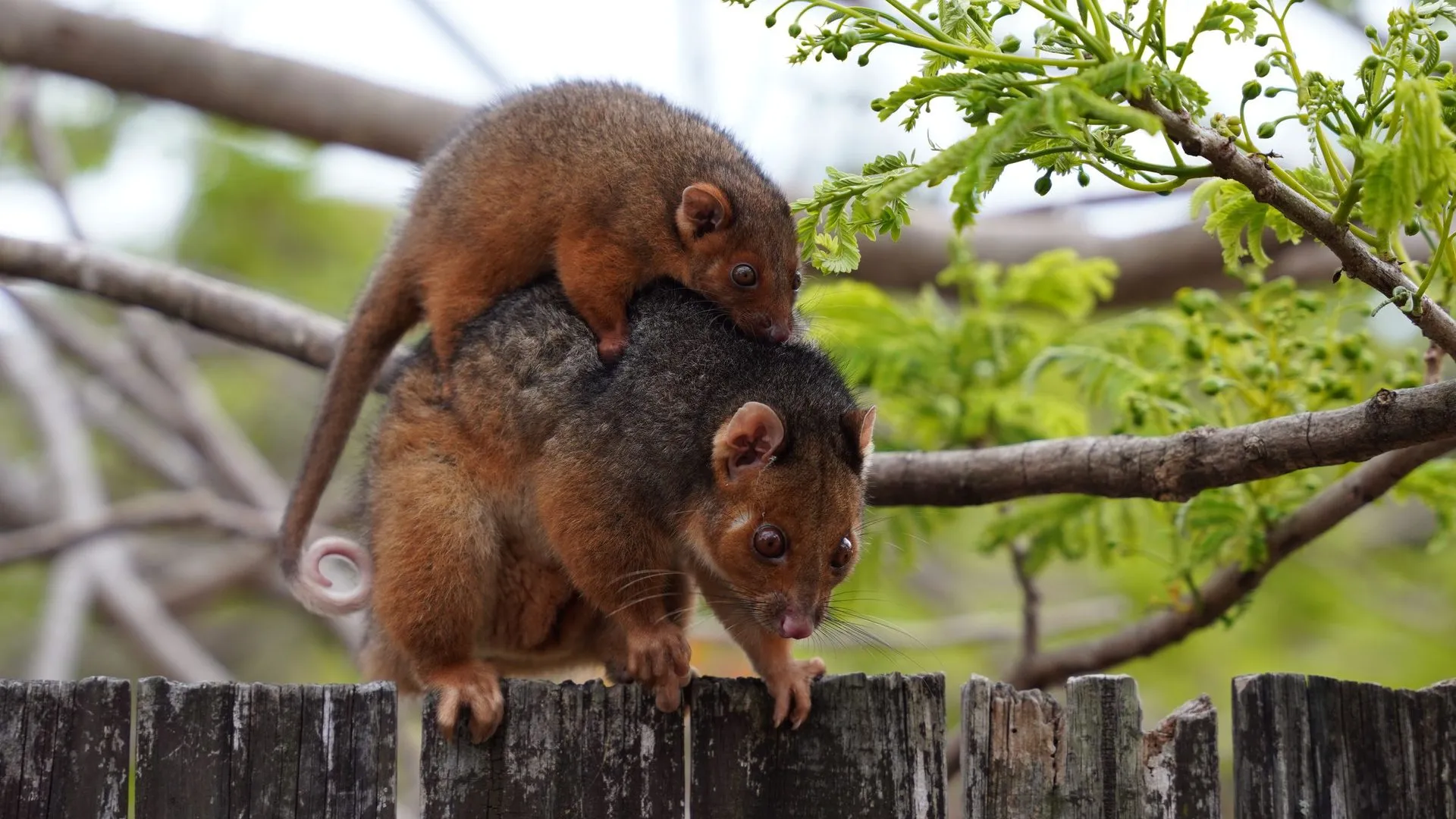
A common brushtail possum in your Adelaide roof is protected wildlife under the South Australian National Parks and Wildlife Act 1972. You cannot legally kill it, you cannot legally relocate it more than a short distance from where you trapped it, and you cannot legally keep it. Lawful possum removal in Adelaide is a specific protocol: cage trap on the property, same-property release within the regulated distance, and immediate exclusion of the roof entry point so the same possum (or any other) cannot return. “Off-site relocation” isn’t what the rules allow.
This article explains the two species you will actually have, what the Act requires, what lawful removal looks like in practice, what it costs in Adelaide, and why following the rules gives a better result for you and the possum.
The two possum species you’ll have in Adelaide
Two species are common across metropolitan Adelaide.
Common brushtail possum — Trichosurus vulpecula
- Size: 2-4 kg adult.
- Appearance: Grey-brown body, bushy tail, large pointed ears, pink nose.
- Behaviour: Solitary, territorial, active at night.
- Habitat preference: Roof voids, wall cavities, garage ceilings, tree hollows. The classic “thumping in the roof at 3am” possum.
- Where in Adelaide: Across the metro grid; very heavy pressure in Hills (Stirling, Crafers, Aldgate) and foothills (Belair, Blackwood, Mitcham, Burnside) where bushland-fringe habitat backs onto residential land.
Common ringtail possum — Pseudocheirus peregrinus
- Size: 700 g - 1.1 kg adult — noticeably smaller than brushtail.
- Appearance: Smaller body, prehensile tail with a distinctive white tip, smaller ears.
- Behaviour: Builds dreys (round leaf-and-twig nests) in tree forks, more arboreal, less likely in roof voids.
- Habitat preference: Mature gardens with established trees and dense shrubs.
- Where in Adelaide: Common in inner-east villa stock with mature gardens — Norwood, Walkerville, Unley — but rarely the roof tenant. Garden visitor more than building occupant.
The possum in your roof is usually a brushtail. Ringtails in the building are less common.
What the National Parks and Wildlife Act 1972 (SA) requires
All possum species in South Australia are protected under the Act. The Department for Environment and Water (DEW) administers the protected-species framework. Four rules carry the bulk of the obligation:
- No killing. Possums cannot be legally killed by a homeowner or commercial operator. Lethal control of native wildlife requires a separate permit framework that does not extend to nuisance possums in residential roofs.
- No keeping. A trapped possum cannot be retained. The release window is short — typically same-night release.
- Release within a short distance. DEW guidance specifies release within a short distance of capture (commonly within 50 metres of where the animal was trapped). Possums are territorial, and releasing them away from their home range exposes them to fighting with resident possums and a poor survival outlook. The release-distance rule is a welfare measure, not a convenience rule.
- Sealing the entry point is the responsibility that goes with capture. A trap-and-release without entry-point sealing simply releases the possum a few metres from a roof it knows how to enter. It can be back within days. The Act expects the roof entry to be closed at or before release.
DEW publishes a possum management standard, and trapping requires a DEW capture-and-release permit — homeowners can apply for one themselves, and the same release and welfare rules apply.
For verification: the Act and the management standard are both publicly published and the DEW possum-management page is the single best landing point for homeowners reading up on the law before they ring an operator.
How lawful possum removal actually works in Adelaide
A lawful program is built around the entry-point seal, not around the trap.
The standard sequence
- Roof inspection and entry-point identification. The technician walks the roof line — broken tiles, lifted ridge caps, gaps in eave clearances, unscreened vents, gable end gaps, brick-cavity weep-holes large enough to admit a possum. Brushtails need surprisingly little — a 5-7 cm gap is enough. Ringtails are smaller and fit through proportionally smaller gaps, but they rarely use roofs.
- Cage trap placement. A wire cage trap (typically 80-90 cm long, 30 cm wide) baited with apple, banana or peanut butter, positioned inside the roof void near the active travel route, or at the base of the entry point on the ground. The trap is checked every 24 hours — leaving a trapped animal more than 24 hours is a welfare breach.
- Capture and same-property release. Once captured, the possum is released on the property, usually at dusk, at a sheltered location — under a shrub, near a tree trunk, at the back of the block. Within 50 metres of the capture point per the DEW management standard.
- Entry-point exclusion — completed before release or immediately after. One-way exclusion door fitted at the active entry, then the entry sealed permanently after the possum has exited. Other identified entry points sealed in parallel. Sheet metal, hardware mesh, ridge-cap rebedding, eave clearance closure as appropriate.
- Return visit — confirms no re-entry, checks for missed entry points (a displaced possum will often probe the roof for a while) and checks the condition of the seals.
Why a one-way exclusion door matters
A common method in Adelaide possum work: install a one-way exclusion door at the active roof entry. The possum exits at dusk to forage, the door allows the exit, the possum cannot re-enter. Once there’s been no return activity for several nights, the door is removed and the entry is sealed permanently. This avoids trapping inside the void if the possum has young — a lactating female cannot be left trapped while her offspring are in the roof.
For a verified joey-in-the-roof scenario, the protocol changes — exclusion happens after the joey is independent (typically late summer / early autumn) or the matter is referred to a wildlife rescue service.
Why “we’ll take it to the bush” isn’t the answer
Some services offer to “catch it and take it to the bush”. DEW’s capture-and-release rules require release on the same property, close to where the possum was caught, so off-site relocation isn’t allowed under the permit. It’s also poor for the possum — released into another possum’s territory, it faces fighting and a poor survival outlook.
The honest version of “we’ll get it out and it won’t come back” is the trap-and-same-property-release plus rigorous entry-point sealing. The exclusion is the durability; the trap is the moment.
Adelaide-Hills and foothills considerations
Bushland-fringe properties in the Hills (Stirling, Aldgate, Crafers, Mylor, Mount Barker) and the foothills (Belair, Blackwood, Eden Hills, Mitcham, Coromandel Valley) carry constant possum pressure. The surrounding bush is the source population and territorial replacement is rapid — once one possum is excluded, another from the surrounding population may probe the same property within weeks.
The realistic strategy on these properties:
- Rigorous entry-point sealing — every gap, every vent, every weep-hole, every roof-line clearance.
- Roof-line monitoring — annual inspection of seals and roof condition.
- Possum-friendly garden — leaving alternative shelter (a possum nest box on a back-of-block tree) reduces roof pressure. The Hills suburbs in particular benefit from this because resident possums in nest boxes are less likely to probe the house.
- Avoid attractants — fruit trees with unpicked fruit, accessible compost bins, dog food left outdoors. Each draws possums onto the property.
Possum removal by area: Mitcham, Eden Hills, Blackwood and beyond
The same rules apply in every Adelaide suburb, but the job looks different depending on the housing and how close the bush is.
Mitcham, Eden Hills, Blackwood and Belair
The foothills suburbs sit against Belair National Park, Brownhill Creek and a string of creek-line reserves, so there is always a resident possum population close by. Older homes here often have timber eaves, gable vents and extensions where the new roof meets the old one, and those junctions are where most entry points turn up. Sealing is the main event on these properties: expect the inspection to cover the whole roof line, not just the gap you heard the possum use. If you’re in the foothills, our Mitcham, Belair and Blackwood page covers the termite and pest side of the same housing stock.
Walkerville, Burnside and the leafy eastern suburbs
Large established gardens, mature street trees and older villas with lots of roof junctions make the eastern suburbs reliable possum territory. Trees overhanging the roof are the usual highway, so trimming branches back from the roof line is often part of the fix alongside sealing. See our Walkerville and Burnside pages for local pest and termite work.
Para Hills, Salisbury and the northern suburbs
Possum calls in the north usually come from homes near creek lines and reserves, such as along Dry Creek and the Little Para River. Brick homes from the 1960s to 1980s tend to have fewer entry points than older villas, but gaps at the fascia, around solar and aircon penetrations, and under lifted ridge capping still let possums in. Our Salisbury page covers the wider northern area.
Adelaide Hills townships
Stirling, Aldgate, Crafers and Mount Barker properties are surrounded by habitat, so a possum-proof roof matters more than any single removal. Annual roof-line checks are worth considering here. See the Adelaide Hills page.
Possum or rat? How to tell what’s in your roof
| Sign | Possum | Rat |
|---|---|---|
| Timing | After dark, often loud thumps on and off through the night | Scurrying and scratching, often at dusk and before dawn |
| Sound | Heavy footsteps, thuds, hissing or coughing calls | Light, quick scratching and gnawing |
| Droppings | Larger, pellet-like, often in one spot | Smaller, scattered along runways |
| Smell | Strong urine smell, ceiling stains | Musty smell, grease marks along beams |
| Treatment | Same-property release under permit, then sealing | Baiting or trapping, plus sealing entry points |
If it sounds more like rats, read our winter rodent control guide or see rodent control in Adelaide.
Damage and what it costs to fix
A possum in a roof void typically causes:
- Insulation contamination — urine and faeces saturate the batts where the possum sleeps. Soiled insulation must be replaced; the contamination is permanent.
- Ceiling stains — urine seeps through plasterboard and stains the ceiling below. Stained sections often need to be cut out and replaced.
- Electrical wiring damage — possums chew cabling. Live cable damage is a fire risk and an electrical safety event.
- Noise impact — heavy thumping on rafters, scratching on ceiling, vocalisations at 2-4am. Sleep disruption is the most-reported homeowner complaint.
Replacing insulation, repairing stained ceilings and having wiring checked by an electrician can add up quickly. The longer a possum stays, the bigger the bill — which makes the case for sealing entry points early.
Cost of lawful possum removal in Adelaide
A standard residential possum removal program in Adelaide typically sits in the $300-$650 range, covering:
- Initial roof inspection and entry-point identification.
- Cage trap placement and monitoring (where a permit is in place).
- Capture and same-property release.
- One-way exclusion door installation.
- Permanent sealing of the active entry point.
- Return visit to confirm no re-entry and remove the exclusion door.
Cost variables:
- Multiple entry points push the upper bound up — each additional entry adds labour and materials.
- Double-storey access — height work and ladder access add labour.
- Complex roof structures — heritage tile roofs with multiple ridge lines, gable ends, dormers. The inspection takes longer and the seal locations are harder.
- Recurring service contracts — bushland-fringe Hills properties sometimes carry an annual roof-line inspection contract at $200-$400/year as ongoing prevention.
For wider Adelaide pest pricing context, see the pest control cost guide. If your roof tenant turns out to be a rat rather than a possum, the Adelaide winter rodent control guide is the relevant article — different species, different protocol, different chemistry.
When to call us
- Confirmed possum activity in the roof void — thumping, scratching, vocalisations, droppings.
- Visible roof damage — broken tiles, lifted ridge caps, gable-end gap.
- Joey-in-the-roof scenario — a vocal lactating female with offspring above the ceiling. The protocol changes; do not try to handle this yourself.
- Insulation contamination — visible urine staining on ceiling, ammonia odour from the roof void.
- Bushland-fringe property with no current possum issue but a roof line you suspect would not stop a possum probe — preventive sealing inspection.
FAQ
Is it legal to remove a possum from my Adelaide roof? Yes, with the right protocol. Possums are protected under the National Parks and Wildlife Act 1972 — they cannot be killed or relocated off-site. Lawful removal means a DEW capture-and-release permit, release on the same property close to the capture point, and sealing the roof entry point — or a one-way exclusion door so the possum leaves by itself.
How much does possum removal cost in Adelaide? Typical residential range $300-$650, covering inspection, trap placement, monitoring, capture and same-property release, exclusion door, permanent entry sealing and a return visit to confirm no re-entry. Multiple entry points, double-storey access and heritage roof complexity push the upper end up.
Can the possum come back after removal? A trap-and-release with no entry-point sealing — yes, very likely, and quickly. The same possum knows the roof. A trap-and-release with thorough entry-point sealing — no, that possum cannot re-enter. New possums from the surrounding population may probe the property over weeks to months, especially on bushland-fringe land — which is why annual roof-line monitoring is the right posture in Hills suburbs.
Is it illegal to relocate a possum off my property in SA? Under DEW’s capture-and-release permit, possums must be released on the same property within a short distance of where they were caught (DEW guidance refers to within 50 metres). Releasing them elsewhere isn’t allowed under the permit and gives the possum a poor survival outlook.
Will pest control kill possums in Adelaide? No. Killing protected native wildlife is unlawful under the Act. Possum work is about exclusion and permitted same-property release — not lethal control. If someone offers to “get rid of” a possum by killing it, don’t engage them.
What should I do about a dead possum in my roof? Don’t leave it: the smell gets worse and it attracts flies. If you can reach it safely, wear gloves, double-bag it and put it in your general waste bin, or check your council’s advice on disposing of dead animals. If it’s out of reach in the roof void or wall cavity, ask us when you request a quote and we’ll talk you through access, odour treatment and sealing the entry point so it doesn’t happen again.
Who do I call for possum removal in Adelaide? Choose a pest controller who works within DEW’s capture-and-release rules, explains how they’ll seal entry points, and gives you a written quote first. You can request a quote from Pest Fox online and we’ll get back to you within 24–48 hours.
Sources
- South Australia Department for Environment and Water — Managing Possums: https://www.environment.sa.gov.au/topics/animals-and-plants/living-with-wildlife/possums/managing-possums
- South Australia National Parks and Wildlife Act 1972 (current version): https://www.legislation.sa.gov.au/__legislation/lz/c/a/national%20parks%20and%20wildlife%20act%201972/current/1972.56.auth.pdf
- DEW Common Brushtail and Common Ringtail Possum Management Standard: https://cdn.environment.sa.gov.au/environment/docs/aus_possum_management_standard.pdf
- DEW — Capture and release wildlife permits: https://www.environment.sa.gov.au/licences-and-permits/wildlife-permits/capture-release